
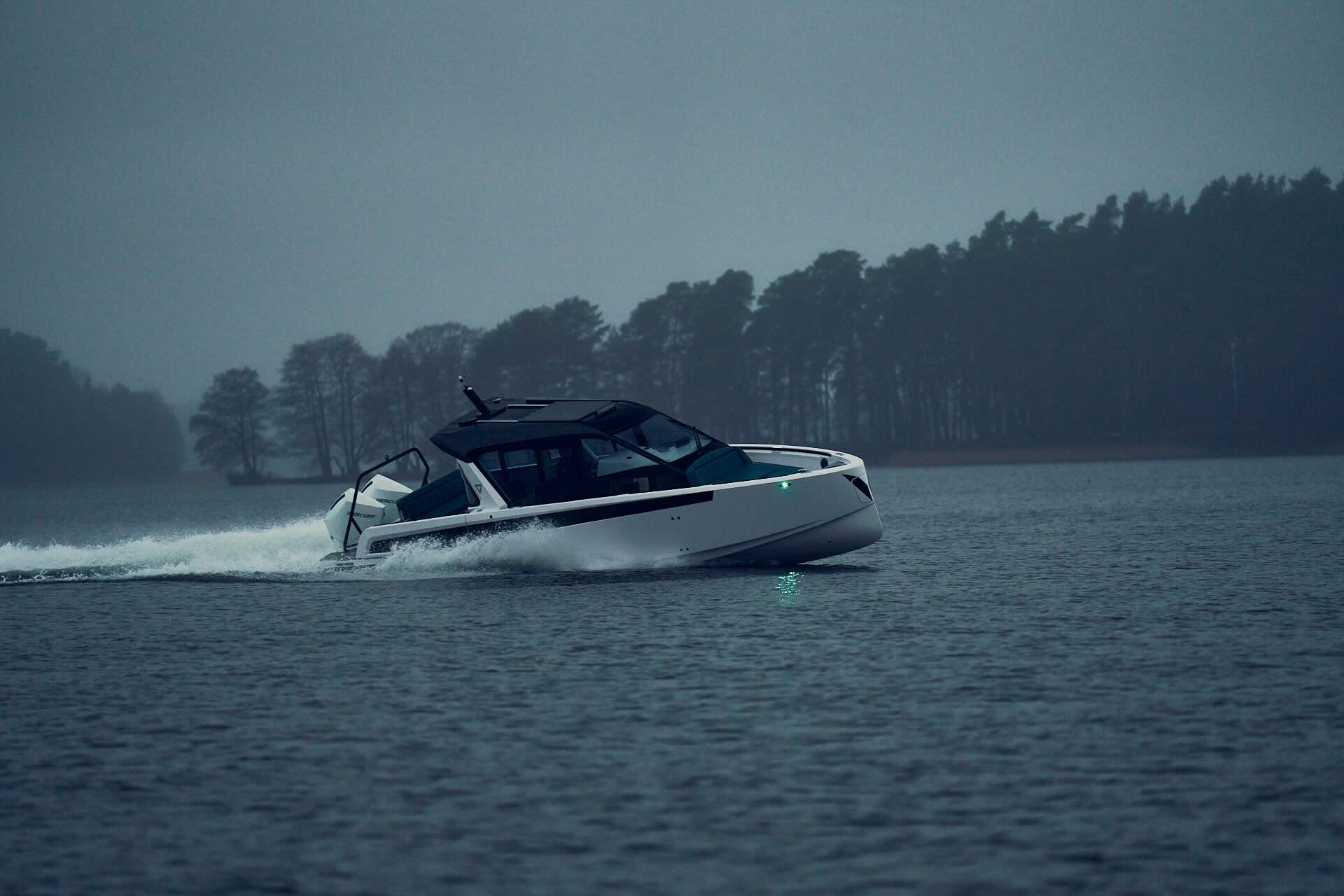
There is a particular kind of afternoon on Sydney Harbour when a boat reveals its true character. It is a moment every seasoned skipper knows well, and quietly dreads. The wind, which had been a gentle companion through the morning, builds to a steady, insistent force, pushing hard against the tide in a relentless tug-of-war. The ferry wakes begin arriving at awkward, unpredictable angles. What looked like a manageable stretch of water from the calm of the marina transforms into a confused, short chop, a liquid proving ground that mercilessly exposes the difference between a boat that photographs well and one that truly, genuinely performs.
It was in precisely these conditions that the Virtue V10 began to make profound sense.
At first glance, the V10's appeal is undeniably visual. Its proportions are taut and athletic, the sheerline clean and unbroken, the stance purposeful without ever tipping into aggression. It is a vessel that commands attention at the dock. But it is only when the throttles are advanced and the hull begins to work that you understand where the V10's real, unshakeable confidence lies, not in what you can see, but in what you cannot.
Beneath the surface, out of sight but deeply felt, is a Petestep hull, a revolutionary design developed in Sweden that represents one of the most significant advances in small-boat naval architecture in recent decades. This is not merely a stepped hull in the traditional sense. Where a conventional stepped hull simply introduces a break in the running surface to trap air and reduce wetted area, the Petestep system is a far more considered piece of engineering. Its deflectors are positioned and shaped with scientific precision to intercept the spray sheet at the water-to-hull intersection, redirecting it backwards rather than allowing it to travel up the hull side and create drag. The result is a cushion of ventilated air that reduces resistance without compromising an ounce of directional stability or control.
The numbers behind this technology are compelling. Independent testing has demonstrated that Petestep hulls can achieve up to a 35 per cent reduction in the energy required to propel the boat forward at cruising speeds, and a reduction in vertical acceleration, the force that causes that jarring, fatiguing slam, of approximately 30 per cent compared to a conventional deep-vee bottom. These are not marginal gains. They are the kind of improvements that change the character of a boat entirely.
In practical, real-world terms, this translates into three tangible benefits for the V10 owner.
The first, and perhaps the most immediately felt, is comfort. Rather than meeting short, sharp chop with a jarring, bone-rattling slam, the V10 feels measured, composed, and almost impossibly smooth for a boat of its size. There is a subtle but profound softening to the way it lands after a wave, a cushioning effect that dramatically reduces fatigue for both skipper and guests over the course of a long day on the water. It is the difference between enduring a journey and genuinely enjoying every mile of it.
The second is efficiency. The reduced drag from the Petestep design means the boat achieves its cruising speeds with significantly less effort from the engines. Lower resistance naturally translates into improved fuel consumption without sacrificing a hint of performance. The V10 is a sprinter with the endurance of a distance runner.
The third, and arguably the most impressive, is the ability to maintain pace when other boats are forced to pull back. Many boats can achieve impressive top speeds in flat, calm water. Far fewer can hold a comfortable, confident cruising speed when conditions turn unsettled. The V10 doesn't merely tolerate difficult conditions; it encourages progress, instilling a sense of security and control that is genuinely rare in a ten-metre boat.
Design may be what draws your attention at the dock, but it is engineering that earns your trust when you are miles from shore and the conditions have turned. The Virtue V10, in a rare and entirely satisfying marriage of form and function, possesses an abundance of both.