
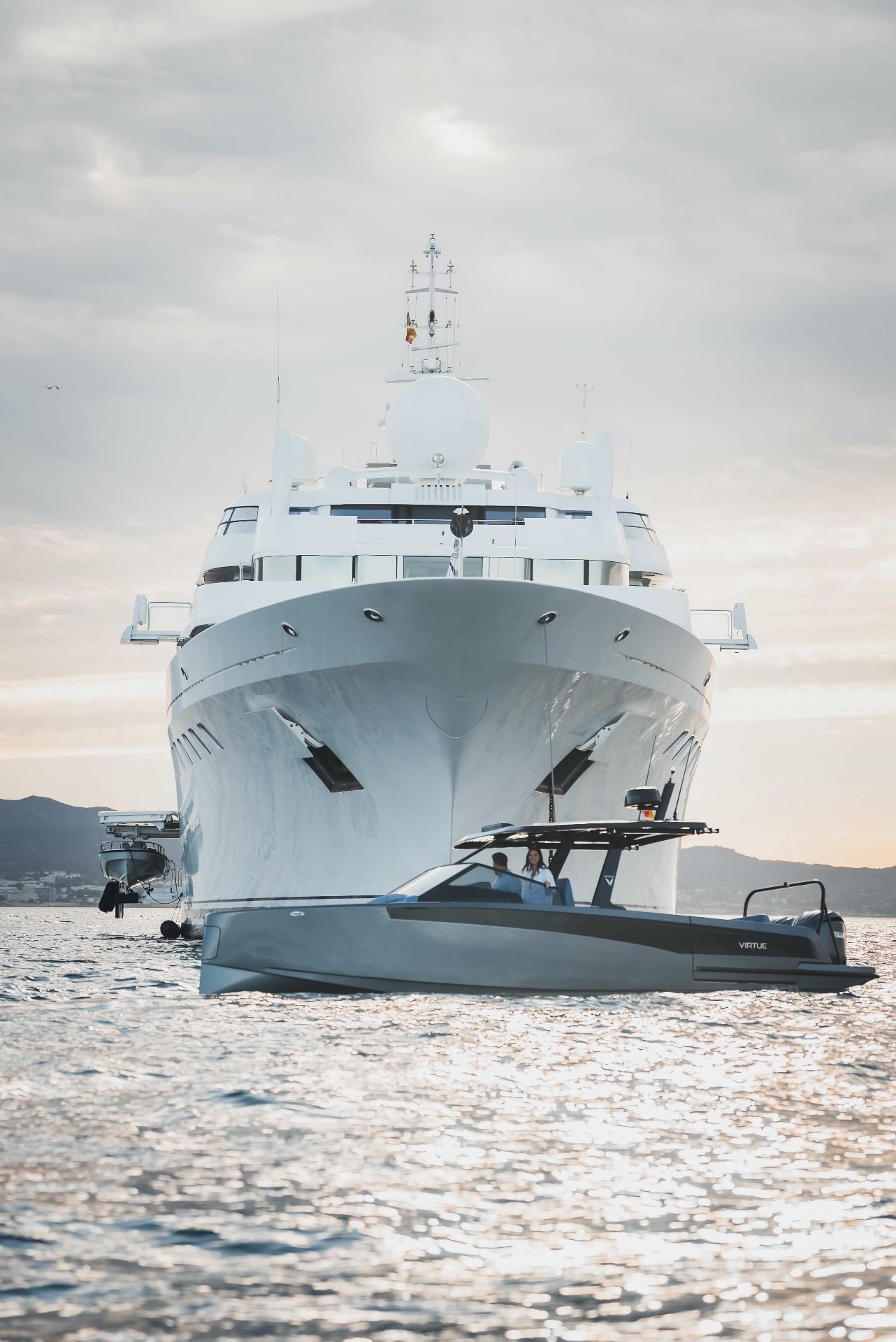
The evolution of the modern dayboat has been a quiet revolution, one that unfolded not in a single dramatic announcement, but through a series of incremental shifts that have, over the course of a decade, entirely transformed what it means to own and use a ten-metre boat.
For decades, the design of boats in this class was dictated by a set of unwritten but immovable rules, constrained above all by the inboard engine and the structural demands of the traditional transom. Space was compartmentalised, movement was restricted, and the relationship between the boat and the water it floated on was often mediated by a bulky engine cover and a fixed, vertical transom wall. You were on the water, but rarely truly of it.
Then, as the efficiency, power, and refinement of outboard propulsion became dominant, a fundamental and liberating shift occurred. Engines moved beyond the confines of the hull, and the old boundary simply disappeared. In its place came a new and exhilarating sense of possibility, a blank canvas for designers willing to rethink not just the layout of a boat, but the entire experience of being on one.
Suddenly, platforms could widen, flowing uninterrupted from one side of the boat to the other. Fold-down balconies, once a novelty reserved for the superyacht world, could be seamlessly integrated into the hull form of a ten-metre boat, extending the usable space at rest in a way that was previously unimaginable at this scale. The dayboat began to resemble a piece of open-plan architecture afloat, a floating terrace, a private platform, a social space designed not merely for travelling, but for living, for gathering, for being present in the moment.
Virtue Yachts didn't simply participate in this shift. They embraced it as a core, non-negotiable tenet of their design philosophy from the very beginning.
The V10's aft entertaining platform is a masterclass in this new way of thinking. At rest, the fold-down wings extend outwards, creating a seamless, uninterrupted surface that connects the cockpit to the water in a way that feels natural and inevitable. Whether moored stern-to in a bustling marina or anchored bow-first onto a secluded beach, the usable footprint of the boat grows in a way that is not just meaningful but genuinely transformative. The boat becomes a different object at rest than it is underway, and that is precisely the point.
This evolution is a direct and honest reflection of how we actually use our boats today. Hosting friends for a long, unhurried lunch at anchor matters. Gathering the family for a day of swimming and laughter matters. The ability to create a comfortable, spacious, and genuinely inviting social environment on the water is no longer a secondary consideration. It is, increasingly, the primary reason people buy a boat in the first place.
Crucially, this newfound openness has not come at the expense of performance. The V10 remains a true driver's boat, responsive, composed, and genuinely thrilling to handle when the throttles are open. The balance between hosting capability and drivability is not a compromise; it is an achievement, the result of considered design rather than convenient trade-offs.
Modern boating is no longer defined solely by the journey from A to B. It is defined by the quality of the experience, by the moments created at anchor, by the memories that linger long after the boat is back on its mooring. The open platform of the Virtue V10 understands this completely.